
The Danger of Assumptions: How They Distort Reality
مفروضوں کا خطرہ: وہ کیسے حقیقت کو مسخ کر دیتے ہیں
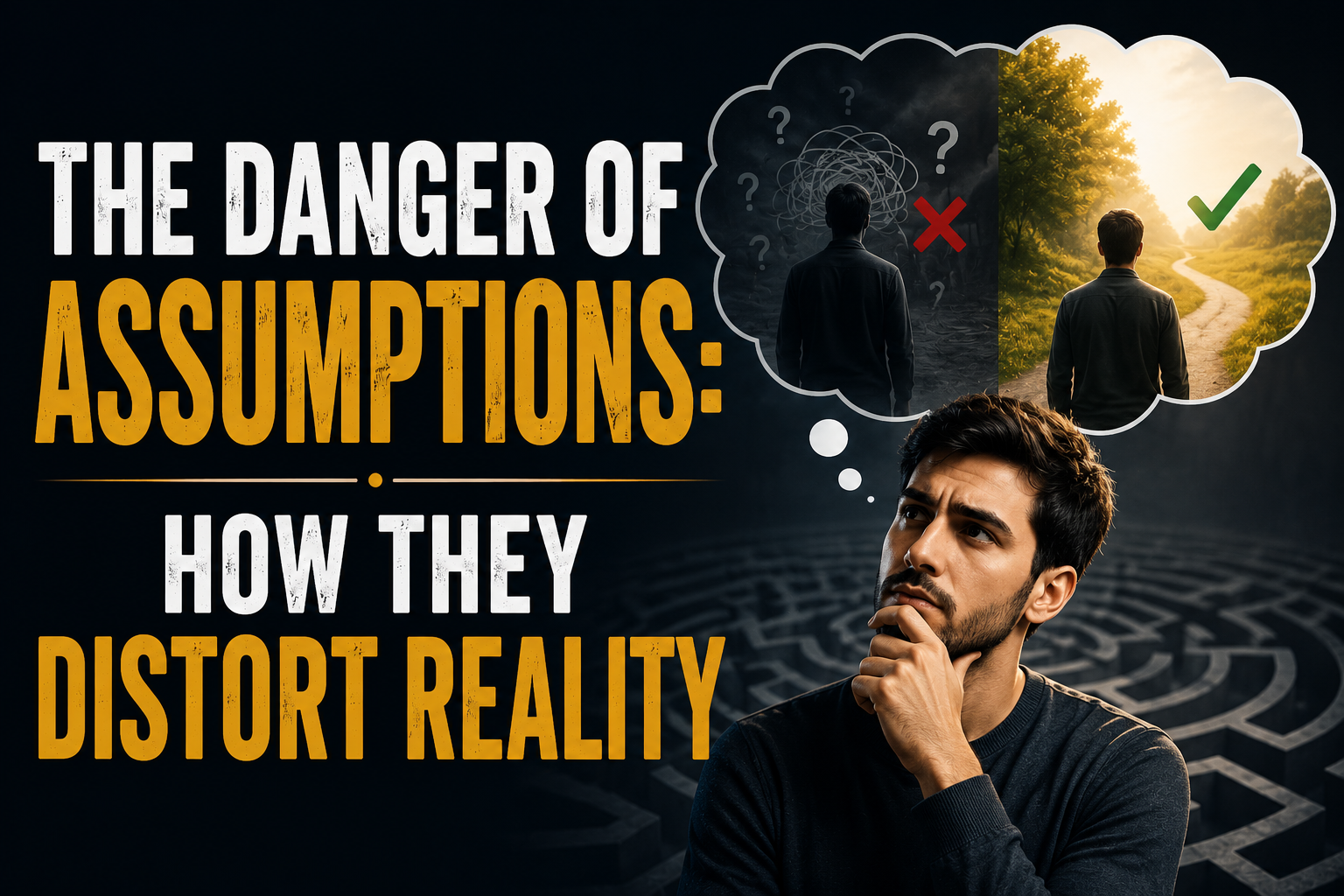
Imagine receiving a short message from a friend that simply says, "We need to talk."
Before the conversation even happens, your mind begins creating stories.
"Did I do something wrong?"
"Are they upset with me?"
"Have I disappointed them?"
Hours later, you discover they simply wanted your advice about a personal matter.
Nothing was wrong—except the story your mind had created.
This happens every day. We fill gaps in information with assumptions, treating them as facts. Without realizing it, we judge people, damage relationships, increase our anxiety, and make poor decisions based on conclusions that were never true.
Critical thinking begins when we stop asking, "What do I think happened?" and start asking, "What evidence do I actually have?"
Islam Warns Against Acting on Assumptions
Allah Almighty says:
"O you who believe! Avoid much suspicion. Indeed, some suspicion is sin."
(Surah Al-Hujurat 49:12)
This verse highlights an important principle of critical thinking: never allow assumptions to become your reality.
Suspicion often begins with incomplete information. Left unchecked, it grows into false accusations, broken trust, and damaged relationships.
Islam encourages believers to seek truth, verify information, and think positively about others whenever possible.
Wisdom from Imam Ali (AS)
Imam Ali (AS) said:
"Place your brother's affair in the best light until what overcomes you leaves no room for excuse."
Reference: Nahj al-Balagha, Saying 360 (numbering varies by edition).
This timeless advice teaches us to interpret people's actions positively until clear evidence proves otherwise.
Instead of asking, "Why did they do this to me?" we should ask, "Could there be another explanation?"
That simple shift in thinking can save countless relationships.
Why Our Minds Create Assumptions
The human brain dislikes uncertainty.
When information is missing, it quickly fills the gaps using previous experiences, emotions, and personal beliefs.
This process happens automatically.
If a colleague walks past without greeting you, your brain may conclude:
"They don't like me anymore."
Yet the truth could be completely different.
Perhaps they were worried about a family member.
Maybe they were late for an important meeting.
Or perhaps they simply didn't notice you.
Our minds prefer a quick answer over an accurate one.
Unfortunately, quick answers are often wrong.
The Difference Between Facts and Stories
One of the greatest habits of critical thinkers is separating facts from interpretations.
Consider this example.
Fact:
Your manager replied to your email two days later.
Story:
"They're disappointed with my work."
Only the first statement is true.
The second is an assumption.
The problem is that we often react to our stories instead of the facts themselves.
Learning to separate facts from personal interpretations makes our thinking clearer and our decisions wiser.
Confirmation Bias: Seeing What We Expect
Psychologists call one of our strongest thinking errors confirmation bias.
Once we believe something, we unconsciously begin looking for evidence that supports our belief while ignoring anything that contradicts it.
If you believe someone dislikes you, every delayed reply feels intentional.
Every neutral facial expression seems unfriendly.
Every disagreement appears personal.
Meanwhile, all signs of kindness are overlooked.
Our minds become lawyers defending our assumptions instead of judges seeking the truth.
Critical thinking requires the opposite approach.
We must actively search for evidence that challenges our first conclusion.
Assumptions Damage Relationships
Many broken relationships don't begin with betrayal.
They begin with misunderstanding.
A husband assumes his wife no longer appreciates him because she seems quiet.
A wife assumes her husband is ignoring her because he spends more time at work.
A friend assumes they have been forgotten because invitations become less frequent.
In many cases, a simple conversation reveals that neither assumption was true.
The problem was never the relationship.
The problem was the story each person created in their own mind.
Social Media Makes Assumptions Worse
Today's digital world encourages instant judgment.
We see one photograph, one video clip, or one sentence online and immediately form opinions about someone's entire character.
But a few seconds of content rarely tell the complete story.
Critical thinkers understand that context matters.
They resist making confident conclusions based on limited information.
The less information we have, the more careful our judgments should become.
Five Questions Before Reaching Any Conclusion
Whenever you find yourself making assumptions, pause and ask these five questions:
1. What do I actually know?
Separate verified facts from personal interpretations.
2. What evidence supports this belief?
Feelings are not evidence.
Look for objective facts.
3. Is there another possible explanation?
There are usually several explanations for the same situation.
Consider them before choosing one.
4. Have I asked the other person?
Many misunderstandings disappear after one honest conversation.
Never replace communication with imagination.
5. What if I'm wrong?
This question protects us from arrogance.
The willingness to admit we might be mistaken is one of the greatest signs of wisdom.
Practical Habits to Reduce Assumptions
Slow Down Before Reacting
Strong emotions often produce weak decisions.
Give yourself time before responding to situations that upset you.
Verify Information
Never repeat information until you know it is true.
Verification prevents unnecessary conflict.
Listen More Than You Speak
People often reveal important details when they feel heard.
Listening helps replace assumptions with understanding.
Assume Good Intentions
Not every mistake is an act of disrespect.
People become busy, distracted, stressed, and forgetful.
Choosing kindness over suspicion protects both your peace and your relationships.
Stay Curious
Curiosity leads to questions.
Questions lead to understanding.
Understanding leads to better decisions.
Conclusion
Our minds are remarkable, but they are not always accurate.
They constantly create stories to explain incomplete information.
Sometimes those stories are correct.
Many times, they are not.
The Qur'an warns believers against suspicion.
Imam Ali (AS) teaches us to think well of others until evidence proves otherwise.
Modern psychology confirms that assumptions and cognitive biases distort our judgment.
Critical thinking is not about doubting everything.
It is about refusing to confuse assumptions with facts.
The next time your mind rushes to a conclusion, pause and ask:
"Am I reacting to reality—or to a story I created?"
That single question could improve your relationships, reduce unnecessary stress, and help you make wiser decisions throughout life.
References
- The Holy Qur'an, Surah Al-Hujurat (49:12).
- Nahj al-Balagha, Saying 360.
- Daniel Kahneman, Thinking, Fast and Slow.
- Julia Galef, The Scout Mindset.
- Carol Tavris & Elliot Aronson, Mistakes Were Made (But Not by Me).
Reflection Question
Think about a recent situation where you felt hurt, angry, or disappointed. How much of your reaction was based on verified facts, and how much was based on assumptions? What might have changed if you had asked one more question before reaching a conclusion?
This article is a collaborative effort between Artificial Intelligence and Prof. Ali Zahoor Mehdi. While AI assisted in drafting, the core insights, refinement, and final approval are strictly the author's work.
Comments (0)
Please keep comments respectful, relevant, and thoughtful.