
Don't Believe Everything You Think: The Hidden Biases That Control Your Decisions
ہر اُس بات پر یقین نہ کریں جو آپ سوچتے ہیں: وہ ذہنی تعصبات جو آپ کے فیصلوں کو متاثر کرتے ہیں
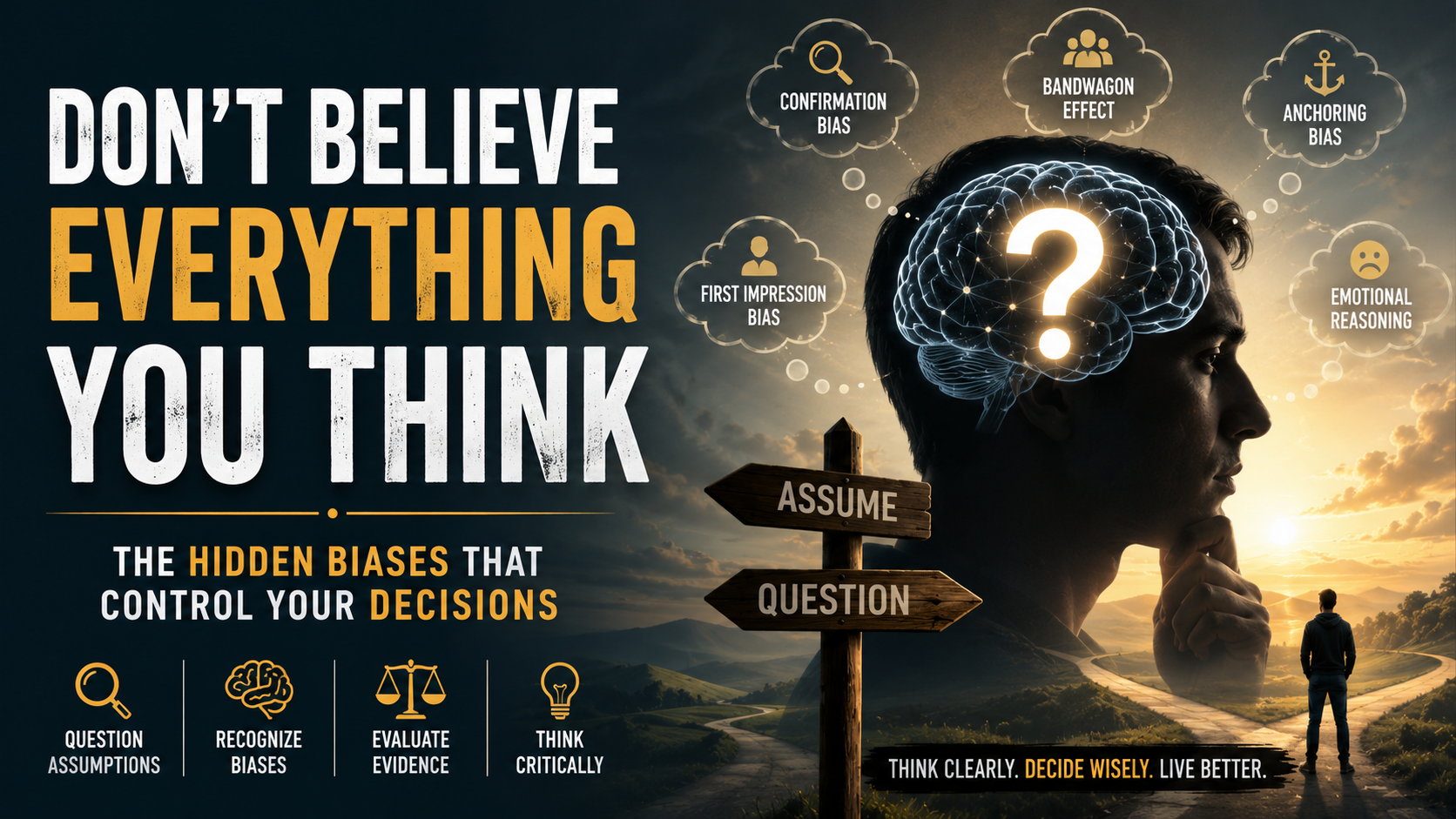
Have you ever made a decision that felt completely right at the time, only to realize later that it was a mistake?
Most of us like to believe we make decisions based on facts and logic. However, psychology tells us a different story. Our brains constantly use mental shortcuts to process information quickly. These shortcuts help us make fast decisions, but they can also lead us to incorrect conclusions without us even realizing it.
These thinking errors are known as cognitive biases.
They influence how we judge people, interpret events, and make decisions in our daily lives. The good news is that once we become aware of these biases, we can think more clearly, make wiser choices, and avoid many unnecessary mistakes.
Critical thinking begins with a simple but powerful idea:
Not every thought that enters your mind is true.
The Qur'an Encourages Reflection
Allah Almighty says:
"Indeed, in that are signs for a people who reflect."
(Surah Ar-Rum 30:21)
Throughout the Qur'an, Allah repeatedly invites believers to observe, reflect, question, and use their intellect. Islam does not encourage blind acceptance. Instead, it teaches us to seek truth through thoughtful reflection and sound reasoning.
Wisdom from Imam Ali (AS)
Imam Ali (AS) said:
"The value of a person is according to the quality of his intellect."
Reference: Ghurar al-Hikam, Hadith 2167 (numbering may vary by edition).
This profound saying reminds us that true intelligence is not measured by how much information we possess, but by how wisely we think and how fairly we judge situations.
What Are Cognitive Biases?
Imagine looking through a pair of tinted glasses without realizing you are wearing them.
Everything appears normal to you, even though the color has changed.
Cognitive biases work in much the same way. They shape our thoughts without our awareness, causing us to misinterpret reality.
These biases affect everyone, regardless of age, education, or experience.
Recognizing them is the first step toward becoming a better thinker.
Confirmation Bias
One of the most common thinking errors is confirmation bias.
This happens when we only look for information that supports what we already believe while ignoring evidence that challenges our opinions.
For example, someone convinced that a particular investment is guaranteed to succeed may only read positive articles while dismissing warnings from financial experts.
Critical thinkers intentionally seek different perspectives before reaching a conclusion.
They understand that hearing opposing views often leads to better decisions.
First Impressions Are Not Always Accurate
We often judge people within seconds.
A person's appearance, confidence, clothing, or way of speaking can shape our opinion before we truly know them.
While first impressions may sometimes be correct, they are far from perfect.
Many honest and capable people appear quiet or ordinary, while some confident individuals may not deserve our trust.
Wise people take time to understand others before making lasting judgments.
Emotions Can Distort Judgment
Our emotions play a powerful role in decision-making.
Anger encourages us to react quickly.
Fear makes problems seem larger than they really are.
Excitement causes us to overlook risks.
When emotions are intense, even intelligent people can make poor decisions.
This is why it is often best to delay important choices until emotions have settled.
A calm mind usually sees more clearly than an emotional one.
The Danger of Following the Crowd
People naturally assume that if everyone believes something, it must be true.
History repeatedly proves otherwise.
Many false ideas, harmful trends, and unfair practices became popular simply because people followed the majority without questioning it.
Popularity is not proof.
Truth should always be supported by evidence, wisdom, and careful thinking.
Learn to Ask Better Questions
Critical thinking begins with curiosity.
Instead of accepting your first thought as fact, pause and ask yourself:
- What evidence supports this belief?
- What evidence challenges it?
- Am I reacting emotionally?
- Could I be misunderstanding the situation?
- What would someone with a different opinion say?
These simple questions help us slow down and think more objectively.
Intellectual Humility Makes You Smarter
In his book Think Again, organizational psychologist Adam Grant explains that truly intelligent people are willing to revise their opinions when presented with new evidence.
Changing your mind after learning something new is not a sign of weakness.
It is a sign of wisdom.
The goal of critical thinking is not to prove ourselves right.
The goal is to discover what is true.
Five Habits of Critical Thinkers
Verify Before You Believe Whether it is news, social media, or a rumor, always check the source before accepting or sharing information.
Listen More Than You Speak People with different experiences may know something you do not.
Listening expands your understanding.
Slow Down Important Decisions Rushed decisions often lead to avoidable mistakes.
Give yourself time to think carefully.
Accept That You Can Be Wrong No one is correct all the time.
Being open to correction is a strength, not a weakness.
Keep Learning Every book you read, every conversation you have, and every new perspective you consider helps strengthen your ability to think critically.
Conclusion
Our minds are remarkable, but they are not perfect.
Every day, hidden biases influence how we think, judge, and make decisions.
The Qur'an encourages believers to reflect rather than blindly follow assumptions.
Imam Ali (AS) teaches that true value lies in the quality of one's intellect.
Modern psychology confirms that recognizing our thinking errors leads to better decisions, stronger relationships, and greater wisdom.
The next time you feel completely certain about something, pause for a moment and ask yourself:
"Do I know this is true, or do I simply believe it is?"
That single question may save you from many unnecessary mistakes.
References
- The Holy Qur'an, Surah Ar-Rum (30:21).
- Ghurar al-Hikam, Hadith 2167 (edition numbering may vary).
- Daniel Kahneman, Thinking, Fast and Slow.
- Adam Grant, Think Again.
- Carol Tavris & Elliot Aronson, Mistakes Were Made (But Not by Me).
Reflection Question
When was the last time you changed your opinion after discovering new evidence, and what did that experience teach you about the importance of critical thinking?
This article is a collaborative effort between Artificial Intelligence and Prof. Ali Zahoor Mehdi. While AI assisted in drafting, the core insights, refinement, and final approval are strictly the author's work.
Comments (0)
Please keep comments respectful, relevant, and thoughtful.