
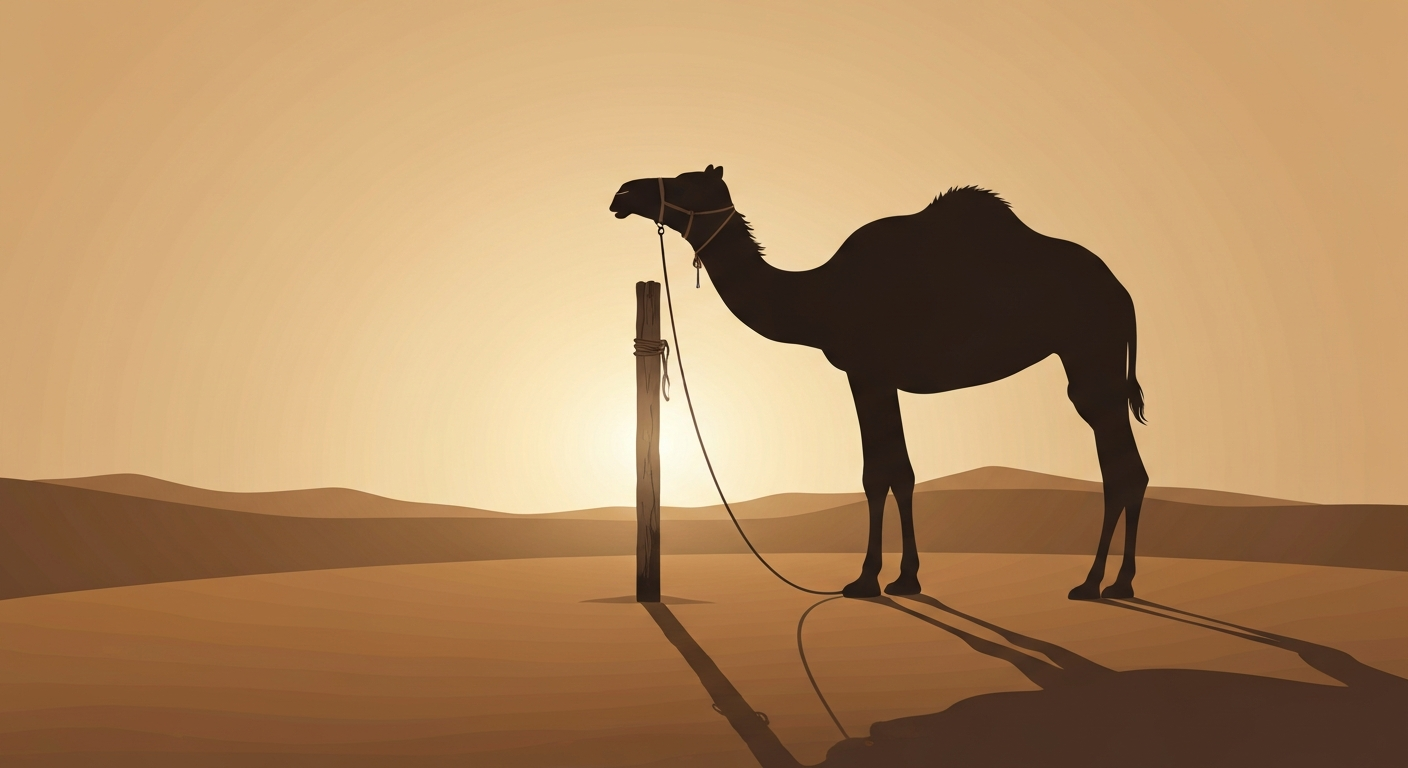
Trust Allah, But Tie Your Camel: Faith and Responsibility Go Together
اللہ پر بھروسہ کریں، لیکن اپنی اونٹنی بھی باندھیں: ایمان اور ذمہ داری ساتھ ساتھ چلتے ہیں
Life is full of uncertainty. We make plans, set goals, work hard, and hope for the best, yet the outcome is often beyond our control. During these moments, many people ask an important question: If I trust Allah completely, do I still need to make every effort?
Islam gives a clear and balanced answer. True faith is not passive. Trusting Allah does not mean abandoning responsibility. It means doing everything within your ability while believing that the final outcome rests with Allah alone.
This beautiful balance between effort and reliance is one of the most practical lessons in Islam. It teaches believers to work with determination while keeping their hearts attached to Allah rather than to their own abilities.
What Is Tawakkul?
Tawakkul means placing complete trust and confidence in Allah after making sincere efforts.
It is not an excuse for laziness, poor planning, or avoiding responsibility. Instead, it is the peace that comes from knowing that after you have done your best, Allah is the Best of Planners.
A believer works with commitment but accepts every outcome with faith.
A Timeless Teaching of the Prophet (ﷺ)
A man once asked the Prophet Muhammad (ﷺ):
"Should I leave my camel untied and trust Allah, or should I tie it and then trust Allah?"
The Prophet (ﷺ) replied:
"Tie it, and then trust in Allah."
Reference: Jami' al-Tirmidhi, Hadith 2517.
This simple conversation contains a powerful life lesson.
Islam teaches us to take practical steps before expecting results. Trust in Allah never replaces personal responsibility. Instead, responsibility is part of trust itself.
The Qur'anic Foundation of Tawakkul
Allah says:
"...And when you have decided, then rely upon Allah. Indeed, Allah loves those who rely upon Him."
Surah Aal-e-Imran (3:159)
Notice the order in this verse.
First comes consultation, planning, and decision-making.
Only then does Allah command believers to place their trust in Him.
This teaches us that Islam encourages thoughtful action before reliance.
Faith Does Not Eliminate Effort
Sometimes people misunderstand Tawakkul by thinking they only need to pray while neglecting action.
A student prays for success but never studies.
A business owner asks Allah for prosperity but refuses to improve their business.
A person wishes for better health but ignores exercise and healthy habits.
This is not Tawakkul.
Islam encourages believers to combine prayer with action, faith with preparation, and hope with hard work.
Allah has created a world of causes and consequences. We are responsible for making use of the opportunities He provides.
Trusting Allah During Uncertainty
Even after careful planning, life does not always go according to our expectations.
Sometimes opportunities disappear.
Sometimes businesses fail.
Sometimes examinations do not go well.
Sometimes doors close despite sincere effort.
This is where Tawakkul brings peace.
A believer understands that Allah sees what we cannot see. What appears to be a disappointment today may become a blessing tomorrow.
Trust in Allah allows us to move forward without becoming overwhelmed by fear or regret.
Practical Examples of Tawakkul
For Students
Study consistently, prepare well, ask questions, and then pray to Allah for success.
For Professionals
Work honestly, improve your skills, and perform your responsibilities with excellence while trusting Allah with the results.
For Business Owners
Plan carefully, serve customers sincerely, manage finances wisely, and remember that provision ultimately comes from Allah.
For Parents
Raise children with love, guidance, and good values while praying that Allah protects and guides them throughout their lives.
In every situation, action and faith walk together.
What Tawakkul Is Not
Tawakkul is not:
- Ignoring responsibilities.
- Refusing to plan.
- Expecting miracles without effort.
- Blaming destiny for personal negligence.
True reliance on Allah inspires action rather than replacing it.
The stronger a person's faith becomes, the more responsible they become.
The Peace That Comes from Trusting Allah
One of the greatest blessings of Tawakkul is inner peace.
People who rely only on themselves often become anxious because they believe everything depends on them.
Believers understand that they are responsible for effort, but they are not responsible for controlling every outcome.
This realization reduces unnecessary worry.
It allows people to work hard without becoming consumed by fear of failure.
Their hearts remain calm because they know Allah's wisdom is greater than their own plans.
Lessons for Modern Life
Today's world encourages constant competition and pressure.
People compare careers, income, achievements, and lifestyles.
Many feel anxious because they believe success depends entirely on personal ability.
Islam offers a healthier perspective.
Do your best.
Improve every day.
Make wise decisions.
Then place your trust in Allah.
When effort is combined with faith, success becomes more meaningful and failure becomes easier to bear.
Conclusion
The lesson of "Tie your camel and trust Allah" remains one of the most practical teachings in Islam.
Faith does not remove responsibility.
Responsibility strengthens faith.
Every prayer should be followed by sincere effort.
Every plan should end with trust in Allah.
When we combine hard work with reliance upon our Creator, we develop confidence without arrogance, patience without despair, and hope without fear.
True Tawakkul is not waiting for life to happen.
It is doing everything within our ability while believing that Allah will always choose what is ultimately best for us.
References
- The Holy Qur'an, Surah Aal-e-Imran (3:159).
- Jami' al-Tirmidhi, Hadith 2517 ("Tie it, and then trust in Allah.").
- Riyad as-Salihin, Imam al-Nawawi, chapters on reliance upon Allah (Tawakkul).
- Sahih al-Bukhari, Book of Tawheed and Book of Riqaq (chapters relating to reliance on Allah).
Reflection Question
When I face challenges, do I simply hope for the best, or do I combine sincere effort with complete trust in Allah, knowing that He is the Best of Planners?
This article is a collaborative effort between Artificial Intelligence and Prof. Ali Zahoor Mehdi. While AI assisted in drafting, the core insights, refinement, and final approval are strictly the author's work.
Comments (0)
Please keep comments respectful, relevant, and thoughtful.