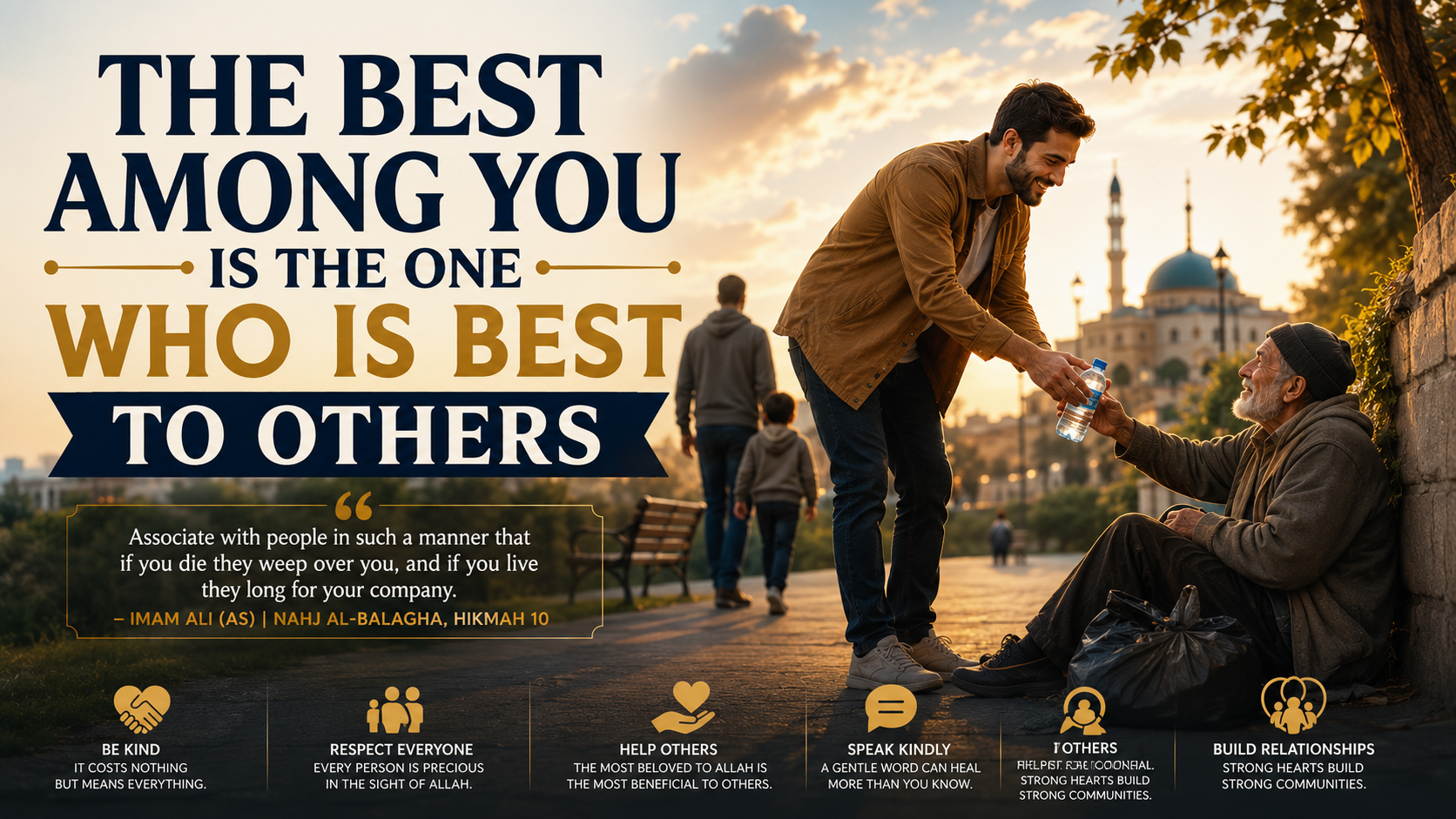
The Best Among You Is the One Who Is Best to Others
بہترین انسان وہ ہے جو دوسروں کے لیے بہترین ہو: اخلاق اور تعلقات پر ایک اسلامی سبق
Every person longs to be respected, valued, and remembered with kindness. We spend years pursuing education, building careers, and achieving personal goals, yet one quality often determines how people truly remember us: the way we treat others.
A smile, a kind word, an act of forgiveness, or helping someone in need may seem small, but these simple actions often leave a deeper impact than wealth or status.
Islam places extraordinary importance on human relationships. The Qur'an repeatedly commands justice, kindness, and compassion, while the Ahl al-Bayt (AS) taught that good character is one of the greatest acts of worship.
Our relationship with Allah is reflected in the way we treat His creation.
The Qur'anic Foundation of Good Character
Allah says:
"Indeed, Allah commands justice, excellence, and giving to relatives, and forbids immorality, wrongdoing, and oppression."
Surah An-Nahl (16:90)
This verse is often described as one of the most comprehensive ethical teachings in the Qur'an.
It calls believers to:
- Be just.
- Show kindness beyond what is expected.
- Care for family and society.
- Avoid harming others.
Good relationships are not optional virtues; they are commands from Allah.
Allah also says:
"Speak kindly to people."
Surah Al-Baqarah (2:83)
Sometimes one kind sentence can heal a heart that has carried pain for years.
A Timeless Lesson from Imam Ali (AS)
Imam Ali (AS) said:
"Associate with people in such a manner that if you die they weep over you, and if you live they long for your company."
Reference: Nahj al-Balagha, Hikmah 10 (edition numbering may vary).
This profound advice teaches us to become people whose presence brings comfort and whose absence is sincerely felt.
True success is not measured by how many people know your name.
It is measured by how many lives became better because you were part of them.
Imam Ja'far al-Sadiq (AS) on Serving Others
Imam Ja'far al-Sadiq (AS) taught:
"The most beloved of people to Allah is the one who benefits His servants the most."
Reference: Al-Kafi, Shaykh al-Kulayni, Kitab al-Iman wa al-Kufr.
This narration reminds us that faith is not limited to prayer and fasting.
Helping people... Removing someone's difficulty... Listening to a worried friend... Supporting parents... Encouraging a struggling student...
All of these are forms of worship when done sincerely for Allah.
Why Kindness Is Never Wasted
Many people hesitate to be kind because they fear being taken for granted.
Islam encourages kindness regardless of whether people appreciate it.
Your reward comes from Allah before it comes from people.
Every sincere smile... Every act of generosity... Every moment of patience... Every word of encouragement...
Is recorded by the One who never overlooks even the smallest good deed.
The Greatest Investment Is Relationships
People often spend years building wealth while neglecting relationships.
Money can purchase comfort. It cannot purchase trust.
Titles can earn authority. They cannot earn genuine love.
Relationships are built through consistent character.
Keeping promises. Speaking honestly. Forgiving mistakes. Respecting differences. Being present when someone needs you.
These small actions become the foundation of lasting relationships.
Lessons from Modern Psychology
Psychologist Dr. John Gottman, whose research on relationships spans decades, found that healthy relationships are built through consistent positive interactions rather than occasional grand gestures.
Similarly, Stephen R. Covey wrote in The 7 Habits of Highly Effective People that trust grows when our actions consistently match our values.
Modern research confirms what Islam taught centuries ago:
Character creates connection. Trust creates lasting relationships. Kindness strengthens communities.
Practical Ways to Become Better to Others
Listen Before You Speak
People often need understanding more than advice.
Listening carefully is one of the greatest gifts we can offer.
Forgive Quickly
Holding onto resentment usually hurts the person carrying it more than the person who caused it.
Forgiveness frees the heart.
Speak with Respect
Disagreements are natural.
Disrespect is a choice.
Strong character allows us to disagree without insulting others.
Keep Your Promises
Reliability builds trust.
Trust builds relationships.
Help Without Expecting Recognition
The purest acts of kindness are often the ones no one else notices.
Allah notices every one of them.
Building a Legacy Through Character
History remembers many people for their wealth or achievements.
The greatest people, however, are remembered because they made others feel valued.
Imam Ali (AS) remains beloved across generations not only because of his knowledge and courage, but because of his justice, compassion, humility, and service to humanity.
His life teaches us that greatness is measured not by what we possess, but by how many hearts we touch.
Conclusion
Every day gives us countless opportunities to make someone's life easier.
A kind word. An honest conversation. A helping hand. A forgiving heart.
These actions require very little, yet they can transform lives.
The Qur'an commands kindness. The Ahl al-Bayt (AS) embodied kindness. Modern research confirms the power of kindness.
The question is whether we choose to practice it.
When people remember us, may they remember someone who brought peace rather than conflict, hope rather than discouragement, and compassion rather than judgment.
Because the best among us are not those who own the most, but those who leave the greatest positive impact on others.
References
- The Holy Qur'an, Surah An-Nahl (16:90).
- The Holy Qur'an, Surah Al-Baqarah (2:83).
- Nahj al-Balagha, Hikmah 10 (edition numbering may vary).
- Al-Kafi, Shaykh al-Kulayni, Kitab al-Iman wa al-Kufr.
- Stephen R. Covey, The 7 Habits of Highly Effective People.
- John Gottman, The Seven Principles for Making Marriage Work.
Reflection Question
If someone described me through the way I treat others, would they remember kindness, honesty, patience, and compassion, or would they remember something I still need to improve?
This article is a collaborative effort between Artificial Intelligence and Prof. Ali Zahoor Mehdi. While AI assisted in drafting, the core insights, refinement, and final approval are strictly the author's work.
Comments (0)
Please keep comments respectful, relevant, and thoughtful.