Loyalty Is Proven Through Sacrifice, Not Through Claims
وفاداری، دعووں سے نہیں قربانی سے ثابت ہوتی ہے
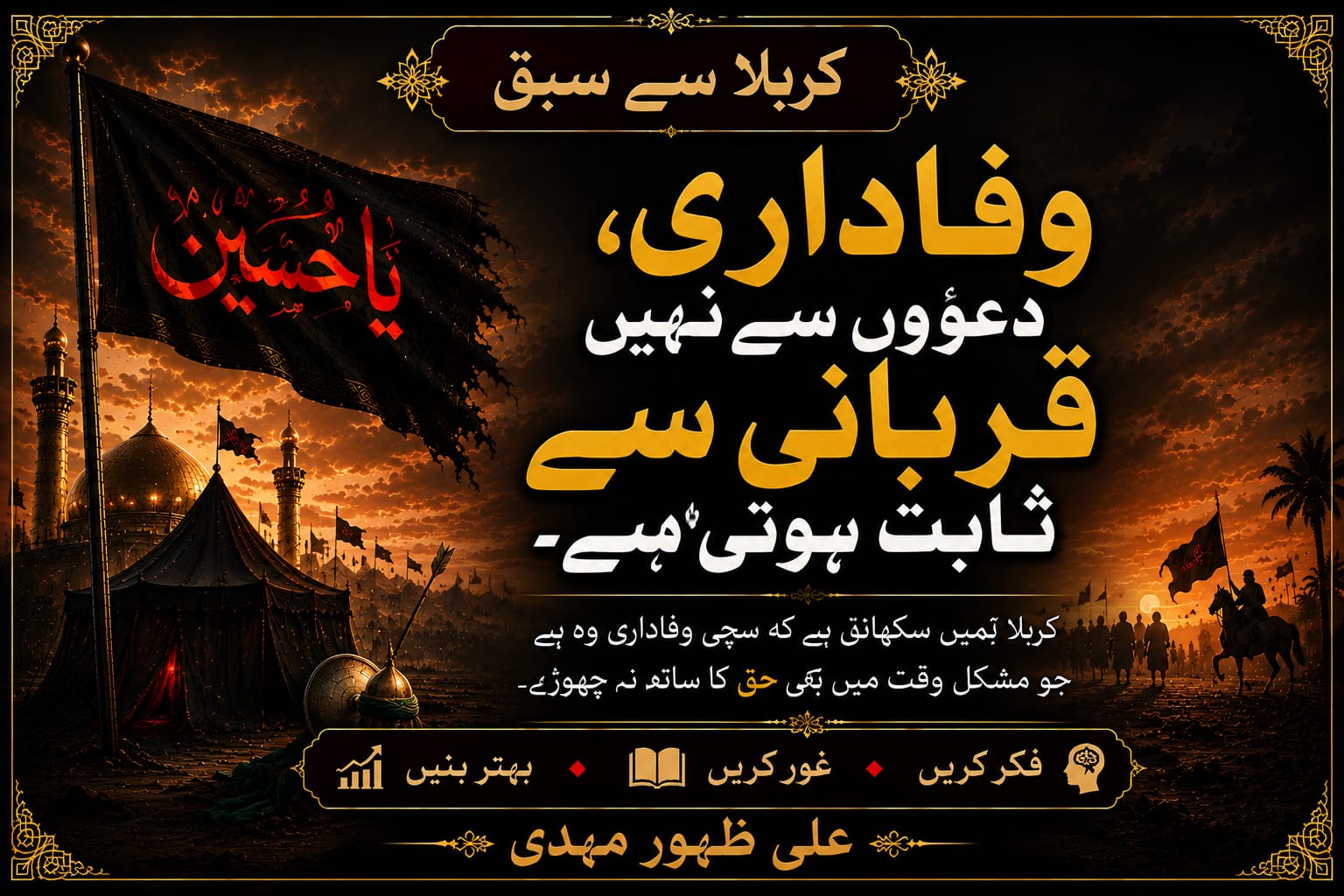
Muharram does not only remind us of grief and remembrance. It also presents some of the highest examples of human character. Among the many lessons of Karbala, one of the most powerful is the lesson of loyalty. Not the kind of loyalty that remains limited to words and emotional claims, but the kind that is proven through action, sacrifice, and steadfastness in times of difficulty.
Many people speak of loyalty when life is comfortable and relationships are easy. But the true value of loyalty appears when circumstances become difficult, when personal interests are threatened, and when sacrifice becomes necessary. Karbala teaches us that loyalty is not tested in ease. It is tested in hardship.
What Loyalty Meant in Karbala
The companions of Imam Hussain (AS) were few in number, limited in resources, and surrounded by a far stronger force. From a worldly perspective, they had many reasons to step back, save themselves, or avoid the consequences of standing with truth. Yet they chose not to abandon Imam Hussain (AS).
Their loyalty was not based on personal benefit, tribal loyalty, or worldly gain. It was loyalty to truth, to faith, to the Imam of their time, and to the moral principles they believed in. Through their sacrifice, the companions of Karbala showed that sincere loyalty is not measured by emotional attachment alone. It is measured by what a person is willing to give up in order to remain faithful.
The Qur’anic Perspective on Loyalty
The Holy Qur’an describes a group of believers in these words:
"Among the believers are men who have been true to the covenant they made with Allah." (Surah Al-Ahzab 33:23)
This verse reminds us that faith is not merely a matter of words. True faith requires a person to honor their commitment, especially when doing so demands sacrifice. A person’s character becomes clear when they are tested by pressure, fear, or loss.
Loyalty, in the Qur’anic sense, is not shallow attachment. It is a serious commitment to truth, trust, and responsibility.
The Relationship Between Loyalty and Sacrifice
Real loyalty always requires sacrifice. Sometimes it demands time. Sometimes comfort. Sometimes personal interest. Sometimes safety. A person who only remains loyal when there is something to gain has not yet understood the meaning of loyalty.
In Karbala, loyalty meant standing with truth despite danger. It meant refusing to walk away even when the path ahead led toward suffering and martyrdom. This is why the companions of Imam Hussain (AS) are remembered not merely as supporters, but as symbols of faithfulness, courage, and honor.
Their loyalty was not passive. It was active, conscious, and costly.
Loyalty in Modern Life
The lesson of loyalty is not limited to Karbala as a historical event. It remains deeply relevant in our lives today.
Every person faces moments when loyalty is tested:
- Loyalty to family when relationships become difficult
- Loyalty to friends when standing by them becomes inconvenient
- Loyalty to principles when compromise appears easier
- Loyalty to truth when silence seems safer
- Loyalty to faith when worldly pressure becomes intense
In many cases, people remain loyal only as long as there is benefit, comfort, or social approval. But when hardship arrives, their priorities change.
Muharram reminds us that loyalty is not an emotional slogan. It is a moral responsibility.
Signs of True Loyalty
True loyalty is visible in a person’s actions. It is not merely claimed. It is demonstrated.
A loyal person:
- Does not disappear in difficult times
- Does not sell principles for personal gain
- Stands by truth even when others turn away
- Honors trust and commitment
- Remains sincere even when loyalty demands sacrifice
This kind of loyalty creates strong character and trustworthy relationships. It also reflects the depth of a person’s faith.
Loyalty to Truth Is Greater Than Loyalty to Comfort
One of the most important lessons from Karbala is that loyalty to truth must be greater than loyalty to comfort.
The companions of Imam Hussain (AS) could have chosen safety. They could have saved their lives by stepping away. Yet they understood that a life preserved at the cost of truth is not true success.
Their example teaches us that loyalty is not simply about being emotionally connected to a person or a cause. It is about remaining faithful when the price of faithfulness becomes high.
What Muharram Teaches Us About Ourselves
Muharram invites us to look inward and ask difficult questions.
- Am I loyal only when life is easy?
- Do I remain committed to truth when there is pressure to compromise?
- Do I honor the people, values, and responsibilities I claim to care about?
- Is my loyalty visible in my actions, or only in my words?
These questions matter because loyalty shapes both our relationships and our spiritual life. A person who cannot remain loyal in small matters will struggle to remain loyal in greater tests.
Conclusion
Karbala teaches us that loyalty is proven through sacrifice, not through claims.
The companions of Imam Hussain (AS) showed the world that standing with truth requires more than emotion. It requires courage, sincerity, commitment, and the willingness to give up personal comfort for a higher cause.
Their loyalty continues to inspire hearts because it was not built on convenience. It was built on conviction.
As we reflect in Muharram, we should not only admire the loyalty of Karbala. We should also ask whether our own loyalty to truth, faith, principles, and relationships can survive when sacrifice is required.
Reflection Question
Am I truly loyal to my principles, my relationships, and the truth, or is my loyalty limited only to times of ease and personal benefit?
This article is a collaborative effort between Artificial Intelligence and Prof. Ali Zahoor Mehdi. While AI assisted in drafting, the core insights, refinement, and final approval are strictly the author's work.
Comments (0)
Please keep comments respectful, relevant, and thoughtful.