Gratitude Turns What You Have Into Enough
شکر وہ نعمت ہے جو موجود کو بھی کافی بنا دیتی ہے
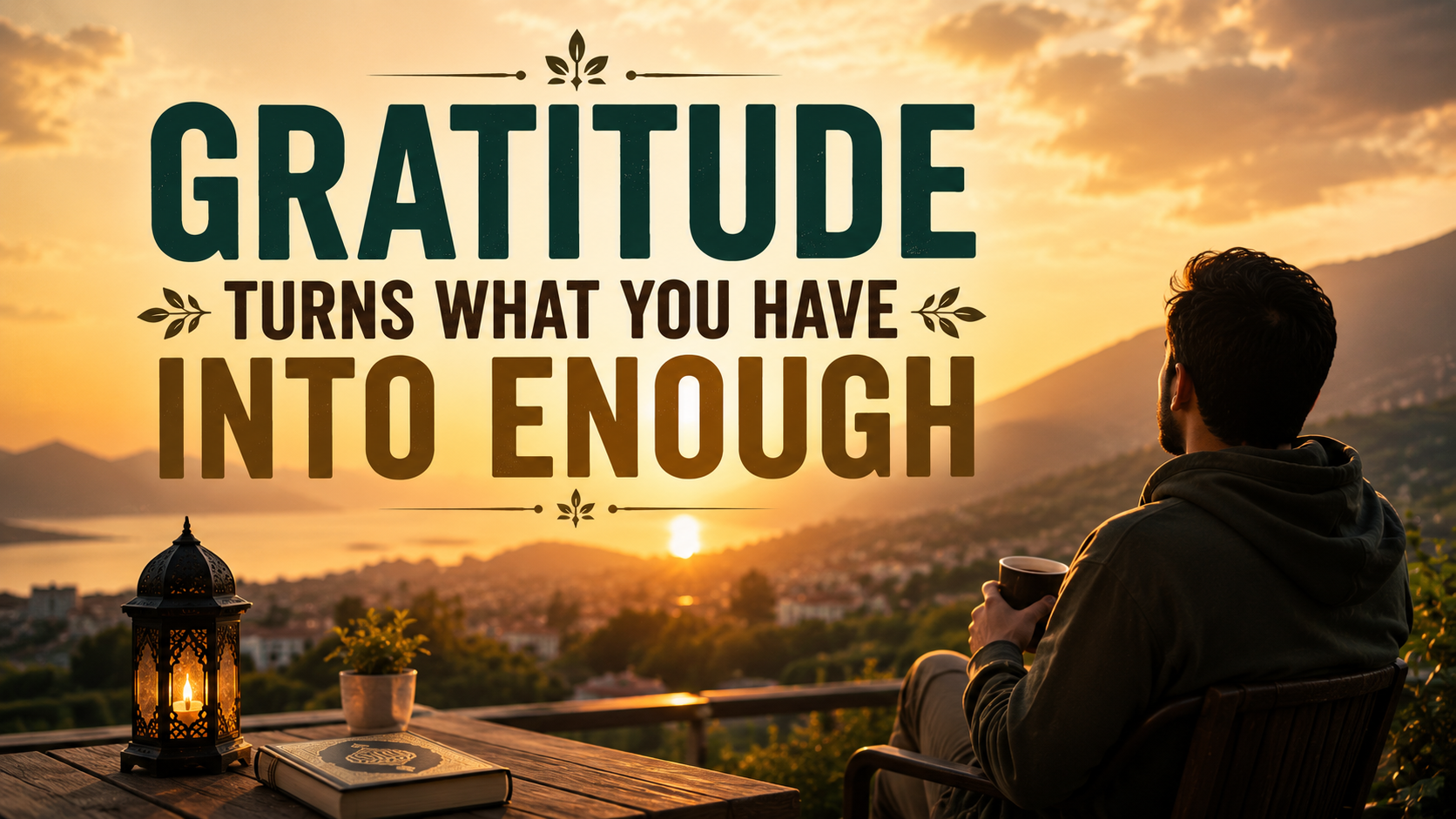
In today's world, it is easy to focus on what we do not have. Social media constantly shows us bigger homes, better jobs, expensive cars, and seemingly perfect lives. As a result, many people spend their lives chasing "more" while forgetting to appreciate what they already possess.
Resulting in restlessness, ingratitude, and a constant desire for "more."
Islam teaches a different perspective.
True happiness is not found in having everything we desire. It is found in recognizing and appreciating the countless blessings Allah has already bestowed upon us.
Gratitude (Shukr) is much more than saying "Alhamdulillah." It is a way of thinking, living, and worshipping. A grateful heart sees blessings where others see limitations, opportunities where others see obstacles, and hope where others see disappointment.
The Qur'an repeatedly reminds believers that gratitude is not only pleasing to Allah but also a means of increasing His blessings.
What Is Gratitude in Islam?
In Islam, Shukr means recognizing Allah as the source of every blessing and using those blessings in ways that please Him.
Gratitude has three dimensions:
The Heart By recognizing Allah's favors.
The Tongue By praising Allah.
The Actions By using His blessings responsibly.
If Allah has given knowledge, use it for the benefit of others.
If He has given wealth, fulfill the rights of the needy from it.
If He has given health, use it in deeds of goodness.
This is complete gratitude.
The Qur'anic Promise
Allah says:
"And when your Lord proclaimed: 'If you are grateful, I will surely increase you; but if you are ungrateful, indeed My punishment is severe.'"
Surah Ibrahim (14:7)
This is one of the most encouraging promises in the Qur'an.
Allah does not specify what He will increase.
Sometimes He increases wealth.
Sometimes health.
Sometimes knowledge.
Sometimes peace of mind.
Sometimes loving relationships.
Sometimes faith itself.
The increase comes in the way Allah knows is best for His servant.
Remember Allah, and Be Grateful
Allah also says:
"So remember Me; I will remember you. Be grateful to Me and do not be ungrateful."
Surah Al-Baqarah (2:152)
Gratitude strengthens our relationship with Allah.
The more we remember Him, the more we recognize His blessings.
The more we recognize His blessings, the more content our hearts become.
A Lesson from Imam Ali (AS)
Imam Ali (AS) said:
"Gratitude for every blessing, even the smallest, is obligatory."
Reference: Ghurar al-Hikam wa Durar al-Kalim, chapter on Shukr.
Many blessings appear ordinary because we experience them every day.
The ability to breathe.
The ability to walk.
A loving family.
Good health.
Peaceful sleep.
Clean water.
These blessings often go unnoticed until they are taken away.
Imam Ali (AS) teaches us to appreciate even the smallest gifts because every blessing is a sign of Allah's mercy.
Imam Ja'far al-Sadiq (AS) on Gratitude
Imam Ja'far al-Sadiq (AS) taught:
"The one who thanks the Giver has truly shown gratitude, even if the blessing is small."
Reference: Al-Kafi, Shaykh al-Kulayni, Kitab al-Iman wa al-Kufr, chapters on Shukr.
Gratitude is not measured by the size of the blessing.
It is measured by the sincerity of the heart.
A grateful believer recognizes Allah's kindness in both abundance and scarcity.
Gratitude Is Not Complacency
Some people think gratitude means accepting every situation without trying to improve it.
Islam does not teach passivity.
A believer may work hard to improve their life while remaining grateful for what Allah has already given.
A student can strive for better grades while thanking Allah for the opportunity to learn.
A business owner can pursue growth while remaining grateful for every customer.
Gratitude and ambition are not opposites.
Gratitude protects ambition from becoming greed.
The Science of Gratitude
Modern psychology has reached conclusions that closely reflect Islamic teachings.
Dr. Robert Emmons, one of the world's leading researchers on gratitude, found that people who regularly practice gratitude experience:
- Greater happiness.
- Lower levels of stress.
- Better sleep.
- Stronger relationships.
- Increased optimism.
Similarly, Dr. Martin Seligman, a pioneer of positive psychology, demonstrated that gratitude improves emotional well-being and resilience.
These findings reinforce what Islam taught centuries ago: a grateful heart is a healthier and happier heart.
Five Practical Ways to Practice Gratitude
Begin Each Morning with "Alhamdulillah" Before checking your phone, thank Allah for giving you another day to worship Him and improve yourself.
Notice the Small Blessings Do not wait for extraordinary events to feel grateful.
Clean water.
A meal.
A smile.
A peaceful moment.
These are blessings many people long for.
Thank People The Prophet Muhammad (SAWW) taught that the one who does not thank people has not truly thanked Allah.
Express appreciation to your parents, spouse, friends, teachers, and colleagues.
Gratitude strengthens relationships.
Use Blessings Wisely Knowledge should benefit others.
Wealth should help those in need.
Health should be used in obedience to Allah.
Every blessing carries a responsibility.
Keep a Gratitude Journal Each evening, write down three blessings from your day.
This simple habit trains the mind to notice Allah's favors instead of life's frustrations.
Gratitude During Difficult Times
Being grateful does not mean pretending life is perfect.
It means trusting that even difficult moments carry hidden wisdom.
Many people later realize that their greatest hardships led to their greatest growth.
A believer thanks Allah not only for what they understand today but also for what they may understand tomorrow.
Faith allows gratitude to exist even during trials.
Conclusion
Gratitude changes far more than our words.
It changes our perspective.
Instead of focusing on what is missing, we begin appreciating what is present.
Instead of constant dissatisfaction, we find contentment.
Instead of comparing ourselves with others, we recognize Allah's unique blessings in our own lives.
The Qur'an promises increase for those who are grateful.
The Ahl al-Bayt (AS) taught that every blessing deserves appreciation.
Modern research confirms that gratitude improves both mental and emotional well-being.
The next time you feel that you do not have enough, pause for a moment.
Look around.
Remember Allah.
Say Alhamdulillah with sincerity.
You may discover that you already possess far more blessings than you had realized.
References
- The Holy Qur'an, Surah Ibrahim (14:7).
- The Holy Qur'an, Surah Al-Baqarah (2:152).
- Ghurar al-Hikam wa Durar al-Kalim, chapter on Shukr.
- Al-Kafi, Shaykh al-Kulayni, Kitab al-Iman wa al-Kufr, chapters on Shukr.
- Robert Emmons, Thanks!: How the New Science of Gratitude Can Make You Happier.
- Martin E. P. Seligman, Flourish.
Reflection Question
Do I spend more time counting the blessings Allah has already given me, or comparing my life with what others have? Which habit is bringing me closer to contentment and gratitude?
This article is a collaborative effort between Artificial Intelligence and Prof. Ali Zahoor Mehdi. While AI assisted in drafting, the core insights, refinement, and final approval are strictly the author's work.
Comments (0)
Please keep comments respectful, relevant, and thoughtful.